Medical billing teams are working harder than ever, yet many practices continue to struggle with rising denials, delayed reimbursements, and increasing administrative burdens.
A typical day in a billing department often involves moving from denial management to eligibility verification, then handling prior authorizations, payment posting, claim edits, and countless follow-up tasks. Before the day ends, something inevitably gets delayed — a filing deadline is missed, a secondary claim remains unsubmitted, or an underpayment goes unnoticed.
The issue is not a lack of effort. The problem is that many billing workflows were designed for a healthcare environment that no longer exists.
As payer requirements become more complex and administrative demands continue to grow, manual billing processes are struggling to keep pace. Practices are spending more time fixing problems after they occur rather than preventing them in the first place.
As a result, denial rates increase, cash flow slows down, staff burnout rises, and revenue becomes harder to protect.
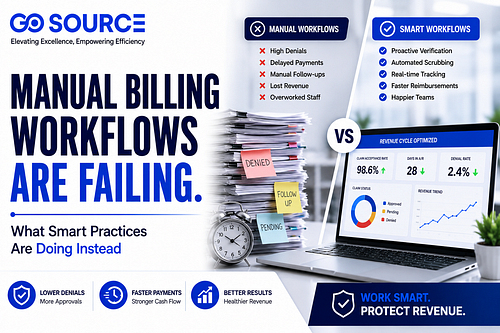
This is why many healthcare organizations are moving toward smarter billing strategies that combine automation, proactive workflows, and specialised expertise to improve efficiency and reduce revenue leakage.
See the most common medical billing mistakes that quietly cost U.S. practices thousands of dollars every month — Read More here.
What a manual billing workflow looks like?
A manual billing workflow depends heavily on staff members completing tasks accurately and on time.
Eligibility verification often requires logging into payer portals and checking coverage individually. Claim scrubbing relies on billers reviewing claims one by one to identify errors before submission. Prior authorizations are frequently tracked using spreadsheets or reminders, while payment posting and denial management require staff to manually review and process information.
These processes can work well when volumes are manageable, and payer requirements are stable. However, today’s healthcare environment is far more complicated.
Even highly experienced teams can miss critical details when workloads increase, staff members are unavailable, or payer policies change unexpectedly. Small errors can quickly turn into denied claims, payment delays, and lost revenue.
The challenge is not that manual workflows are inherently ineffective. The challenge is that healthcare billing has become too complex to rely on manual processes alone.
Why Are Manual Workflows Struggling More Than Ever?
Increasing Payer Complexity
Every payer has unique coverage rules, authorization requirements, coding guidelines, and documentation standards. On top of that, these requirements change constantly.
Keeping up with updates across multiple payers has become increasingly difficult for billing teams. What was acceptable last month may trigger a denial today.
Modern automation tools help address this challenge by applying payer-specific rules consistently and updating requirements in real time, reducing the risk of human error.
Constant Regulatory and Coding Changes
Billing teams must continuously adapt to:
- ICD-10 updates
- CPT code revisions
- CMS policy changes
- Telehealth billing requirements
- Medicare Advantage plan rules
- Expanding prior authorization requirements
Each change requires training, workflow adjustments, and ongoing monitoring. In manual environments, information does not always reach every team member at the same time, creating inconsistencies that often result in preventable denials.
Growing Administrative Workloads
Patient volumes continue to increase while administrative responsibilities become more demanding.
Between authorization management, patient billing, denial follow-up, and revenue cycle reporting, many teams are operating at full capacity. When workloads become overwhelming, urgent tasks naturally take priority.
Meanwhile, important activities such as denial follow-up, underpayment recovery, secondary claim submission, and accounts receivable management are often delayed or overlooked.
Although these issues may seem minor individually, they can create significant revenue leakage over time.
The Efficiency Gap Is Growing
Practices that use modern billing technology are often able to submit cleaner claims, reduce denials, and collect payments faster.
Organisations that continue relying primarily on manual workflows frequently experience lower first-pass claim rates and longer accounts receivable cycles.
Over time, this efficiency gap becomes a competitive disadvantage that affects cash flow, staffing, growth opportunities, and overall financial performance.
What Smart Practices Are Doing Differently?
Successful practices are not necessarily spending more money or building larger billing teams. Instead, they are focusing on process improvements that create the greatest operational impact.
Automating Eligibility Verification
Many practices now run automated eligibility checks before appointments occur.
Coverage issues are identified early, allowing staff to resolve problems before services are provided. This reduces eligibility-related denials while eliminating hours of repetitive manual verification work.
Using Automated Claim Scrubbing
Claim scrubbing technology reviews claims before submission and identifies issues such as:
- Coding conflicts
- Missing modifiers
- Documentation inconsistencies
- Payer-specific edits
- Formatting errors
By catching errors before claims reach payers, practices improve first-pass acceptance rates and reduce the amount of time spent managing denials.
Starting Prior Authorization Earlier
Forward-thinking organisations begin the authorization process at the time of scheduling rather than waiting until the service date approaches.
Early authorization requests provide additional time to resolve payer requirements and significantly reduce last-minute delays or denials.
Making authorization management part of the scheduling workflow is one of the simplest ways to prevent avoidable revenue loss.
Leveraging Specialized Billing Support
For many independent and small-group practices, maintaining a modern billing operation internally has become increasingly difficult.
Technology investments, staff training, compliance requirements, and payer updates require significant resources. As a result, many organisations are partnering with specialised medical billing companies that already have the expertise, infrastructure, and technology needed to manage complex revenue cycle operations.
The goal is not simply to outsource billing it is to build a more efficient, accurate, and scalable revenue cycle.
How to Tell If Your Workflow Is Holding You Back?
You do not need a comprehensive operational review to identify workflow problems. A few key performance indicators often reveal whether your billing operation is functioning effectively.
Days in Accounts Receivable (AR)
Healthy revenue cycle operations generally maintain AR below 35 days.
Consistently exceeding 50 days may indicate workflow bottlenecks, unresolved denials, payment posting delays, or inefficient follow-up processes.
First-Pass Claim Rate
This metric measures how many claims are paid without corrections or resubmissions.
High-performing practices typically maintain first-pass claim rates above 95%. Rates below 90% often suggest preventable errors are reaching payers.
Denial Rate
A denial rate below 5% is generally considered strong.
When denial rates rise above 10%, recurring workflow issues such as eligibility gaps, authorization problems, coding errors, or documentation deficiencies are often the underlying cause.
Net Collection Rate
Net collection rate measures how much collectible revenue is successfully recovered.
Most successful practices maintain rates above 95%. Lower performance may indicate revenue loss caused by unresolved denials, underpayments, or ineffective follow-up processes.
If one or more of these metrics consistently falls outside industry benchmarks, your billing workflow may be impacting financial performance more than you realise.
The Takeaway
Healthcare billing has become significantly more complex than it was a decade ago.
Payer requirements change constantly, authorization demands continue to expand, and administrative workloads are growing across nearly every speciality. As a result, workflows that rely heavily on manual processes are becoming increasingly difficult to sustain.
The practices achieving the strongest financial results are not necessarily reinventing their revenue cycle. Instead, they are automating repetitive tasks, identifying problems before claims are submitted, and leveraging specialised expertise when needed.
By focusing on prevention rather than correction, they reduce denials, improve cash flow, and create a more efficient billing operation overall.
GoSourceMD helps practices eliminate workflow inefficiencies through AI-powered automation, real-time eligibility verification, proactive prior authorization management, and expert billing support designed for today’s healthcare environment.
FAQs
How can I identify which manual workflows are causing the most denials?
Review denial reports and group denials by reason code. Eligibility denials often point to verification issues, authorization denials usually indicate workflow gaps, and coding-related denials may reveal problems with claim scrubbing or documentation processes.
Can I modernize my billing workflow without replacing my practice management system?
Yes. Many eligibility verification, claim scrubbing, and authorization management tools integrate directly with existing practice management systems, allowing practices to improve performance without a complete software replacement.
What process should most practices automate first?
Eligibility verification is often the best starting point. Insurance-related denials are among the most common and preventable causes of payment delays, making eligibility automation one of the fastest ways to improve performance.
How quickly can practices expect results?
Results vary by workflow, but many practices see fewer eligibility-related denials within 30 days. Improvements in claim acceptance rates often appear within 30 to 60 days, while broader revenue cycle metrics typically stabilize within three to four months.